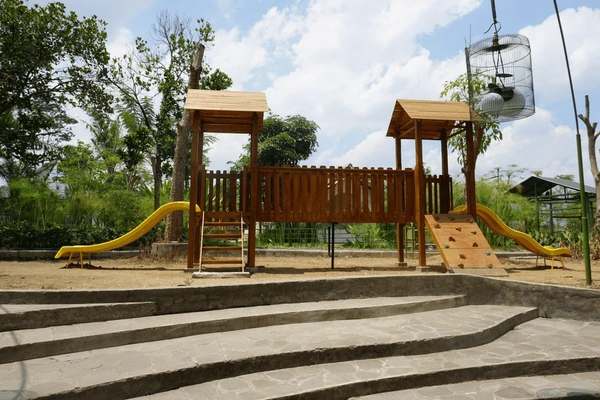
If you have ever sat through a playground presentation, you have probably been blinded by technical jargon regarding “Impact Absorbency” and “G-max scores.”
It is incredibly easy to get bogged down in the data, but your playground surface choice ultimately dictates three things: safety compliance, your long-term maintenance budget, and how much time your site team will spend sweeping loose bark back into a pit.
At Monkey Business Design, we don’t just look at what looks pristine on day one. We engineer play spaces for a 20-year lifecycle, and your surface choice is the literal foundation of that longevity. Here is our honest, straight-talking breakdown of what actually works on a school estate.
Key Takeaways
- Match the Critical Fall Height: Every surface must legally comply with BS EN 1177 standards, ensuring the cushioning depth matches the maximum fall height of your equipment to prevent severe trauma.
- Stop the Softwood Rot: Loose play bark requires endless weekly raking and a costly 10 – 20% annual top-up budget because it compacts and decays rapidly in damp UK weather.
- Invest in the Sub-Base: A playground surface is only as stable as the drainage beneath it; skimping on groundworks causes rubber to split and grass to sink within two seasons.
- Blend Surfaces for Best ROI: Combining hard-wearing bonded rubber mulch in high-traffic drop zones with synthetic grass mounds maximises your budget while providing rich texturing.
- Utilise Existing Tarmac: You don’t always need costly excavation and soil removal; modern materials like bonded rubber mulch can often be engineered directly over your existing hard standing.
Why Does Your Choice Of Playground Surface Matter So Much?
Safety isn’t just an item on a site manager’s checklist; it is a reality of everyday school life. RoSPA data shows that a massive 80% of playground equipment accidents are falls to the surface, with upper-limb fractures making up 84% of the resulting hospitalisations.
While we believe experiencing a degree of physical challenge is essential for a child’s development, the surface beneath them dictates whether they dust themselves off after a slip or end up spending the afternoon in A&E.
Under BS EN 1177, surfacing is scientifically tested to measure its Critical Fall Height (CFH), giving you a legally verified threshold of protection against head injuries before a spade touches the ground.
What Are The Real-World Performance Differences Between Materials?
When evaluating materials, it is vital to look at how they perform under real-world school traffic rather than just in laboratory testing.
A landmark UK epidemiological study published by the National Institutes of Health (NIH) revealed that playgrounds utilising rubberised surfaces cut the overall injury rate to half that of loose wood bark and down to just one-fifth of the risk associated with concrete or asphalt.
While loose wood fibre provides a beautifully rustic look, it behaves completely differently when wet or compacted, losing much of its impact absorbency. Engineered rubber alternatives provide a stable, consistent level of protection 365 days a year.
How Do The Primary Surfacing Options Compare On Cost and Lifecycle?
| Surface Type | Initial Cost | Maintenance Level | Accessibility | Expected Lifespan |
| Wet Pour Rubber | High | Low (Keep swept) | Excellent | 10–15 Years |
| Bonded Rubber Mulch | Medium | Low | Good | 8–12 Years |
| Play-Grade Bark | Low | High (Raking & Top-ups) | Poor | 1–3 Years (Before decay) |
| Artificial Grass + Shock Pad | Medium-High | Medium (Occasional brush) | Excellent | 10–12 Years |
Why Is Sub-Surface Drainage The Real Secret To A Lasting Playground?
The single biggest mistake we see schools make is spending their entire budget on the pretty top layer while skimping on what goes underneath. In the UK climate, a playground that doesn’t drain is a playground that sits empty.
If water collects beneath wet pour or artificial grass, it destabilises the ground, causing the surface to bubble, split, and sink.
At Monkey Business Design, we treat groundworks as a strict engineering discipline. We install free-draining stone sub-bases that ensure water clears instantly, keeping your safety surface flat, dry, and structurally sound for its entire operational lifecycle.
Evidence of Success: Multi-Textured Surface Engineering
Project Spotlight: Redcliffe Children’s Centre, Bristol
This popular city centre nursery has a great mix of structured and free play. The centrepiece is a pair of tree platforms linked by a rope bridge.
We created this play structure as the centre piece of a larger project with a bike track. There’s an artificial grass mound and tunnel, living walls, mud and sand play, rubber surfacing and other play equipment. This platform has a shop window below.
The cut-out leaf shapes have coloured acrylic which projects autumn colours inside the space when it’s sunny.
How Can You Design A Hybrid Layout That Protects Your Budget?
You do not have to commit your entire site to a single material. The most budget-conscious way to design a school playground is to establish zones based on risk and traffic.
Use highly durable bonded rubber mulch directly under the high-altitude climbing zones where impact absorbency is legally required.
Then, transition into short-pile artificial grass for high-traffic running tracks and natural grass or timber seating for quiet zones. This strategic balancing act keeps your initial capital expenditure down while completely removing the high maintenance costs associated with loose-fill pits.
Build It Once, Build It Right
Your playground surfacing shouldn’t be treated as a last-minute afterthought.
By focusing on material lifecycles and verified slip-resistance from day one, you protect your school from the trap of constant repairs and annual top-ups.
Invest in a solid, engineered foundation, and your school estate will reap the rewards in safety, durability, and happy pupils for over a decade.
Unsure which safety surface complies with your current play towers? Book a Surfacing Audit. We’ll evaluate your current fall heights, ground levels, and drainage to map out the perfect foundation.
FAQs
What thickness of safety surface do we actually need?
It depends entirely on your equipment’s height. For instance, a 25mm shock pad protects up to a 1.3m fall height, whereas a 45mm shock pad is engineered for high fall zones up to 2.5m.
Can safety surfacing be installed over our existing old tarmac?
Yes. Both bonded rubber mulch and artificial grass can be engineered directly on top of sound tarmac, eliminating costly excavation and waste removal fees.
Is bonded rubber mulch safe for early years pupils?
Absolutely. It is made from polyurethane-coated recycled rubber, creating a smooth, wire-free, and non-toxic surface that looks like natural bark but stays completely bound together.
Why does loose bark require so much budget over time?
Loose bark degrades naturally and is carried away on children’s shoes. To pass annual safety audits, you must top it up by 10 – 20% every year to maintain the legal depth.
Does artificial grass get waterlogged during the winter?
Not if it is installed correctly. We use fully porous backings laid over a compacted stone sub-base, allowing heavy rainfall to drain through immediately without puddling.
How long does a typical surfacing installation take?
Most school play areas can be prepared and fully surfaced with rubber mulch or artificial turf within 3 to 5 working days, keeping site disruption to a minimum.
What maintenance does rubber surfacing require?
Very little. Unlike loose bark, it just needs an occasional sweep or leaf-blow to prevent organic matter from breaking down on top of the rubber.