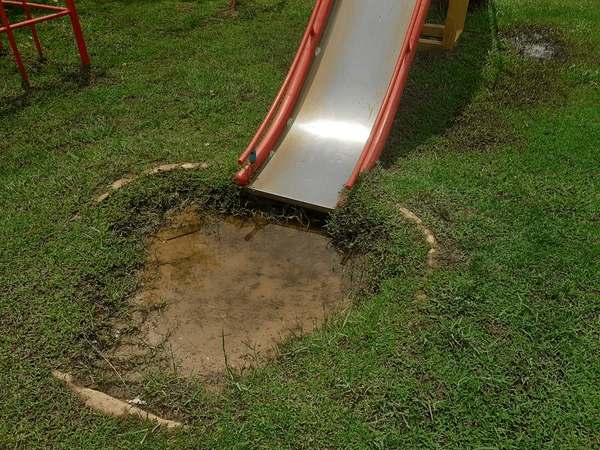
For many schools, the first sign of rain is the signal to start cordoning off the “wild” areas. When the grass turns into a swamp, the site becomes a liability rather than an asset. At Monkey Business Design, we see mud not as a weather problem, but as an engineering failure.
If your site is unusable for four months of the year, your infrastructure isn’t working hard enough for your budget.
To stop outdoor areas from becoming off-limits, you have to manage two things: soil compaction and water flow. This isn’t about digging a hole and hoping; it’s about shifting the way we move across the land.
Key Takeaways
- Soil compaction from repeated foot traffic can reduce water infiltration rates by 70% to 99%, causing rainwater to sit on the surface and turn high-use areas into mud.
- The only long-term fix for persistent mud is to remove traffic pressure from the soil, using elevated boardwalks and all-weather pathways.
- Foundations should be “floating” or installed with screw piles to protect root systems and maintain natural drainage beneath the surface.
- French drains and swales are essential for redirecting and slowing water flow away from high-traffic learning zones.
- All timber structures should be raised on galvanised metal feet to prevent moisture wicking and extend structural lifespan in wet conditions.
Why Does Your Playground Turn Into A Swamp Every October?
The real cause of standing water isn’t just rainfall; it’s what happens beneath your feet.
When groups of students repeatedly cross the same patch of ground, the soil becomes compacted. The natural air pockets that allow water to drain are crushed, leaving the surface unable to absorb rainfall. Instead of soaking in, water sits on top, mixes with the soil, and quickly turns into mud.
This effect is more severe than most people realise. Research on urban soils shows that compaction can reduce water infiltration rates by 70% to 99%, effectively shutting down the ground’s ability to drain. The result is predictable: surface water, slippery conditions, and areas that become unusable for large parts of the school year.
Compaction also has a hidden cost. Around mature trees, it reduces oxygen availability in the soil, placing stress on root systems and accelerating long-term decline.
What looks like a seasonal “weather issue” is actually a design failure in how movement is managed across the site.
Engineering the solution: Boardwalks, Swales, and French Drains
To keep a site functional, you must divert the “traffic” away from the soil. This is where engineered boardwalks and all-weather paths become essential.
By using no-dig floating foundations or galvanised screw piles, we create a permanent walkway that allows the soil underneath to breathe and drain naturally.
For areas where water naturally pools, we utilise French drains or swales. A French drain is a gravel-filled trench that redirects water away from high-traffic zones, while a swale is a shallow, planted channel that slows water down and lets it soak in gradually.
These aren’t just “fixes” you hide; they can be integrated into the habitat as part of a “water cycle” teaching tool.
The Strategic Comparison: Traditional vs. Engineered Access
| Feature | Traditional “Dig-In” Post | MBD “Floating” Engineering |
| Site Impact | High (trenching and compaction). | Minimal (no-dig foundations). |
| Drainage | Often blocks natural water flow. | Permeable (allows water to pass under). |
| Tree Health | Severs roots; causes dieback. | Protects root zones and soil air. |
| Longevity | Prone to “wicking” rot in wet mud. | Galvanised feet break the rot cycle. |
| Site Utility | Area remains muddy and unusable. | 365-day clean access. |
How Managed Flow Protects Your Structural Investment
If you have invested in a timber amphitheatre or a fire-pit shelter, the last thing you want is the base of the structure sitting in a puddle. Standing water is the primary driver of timber decay, even in hardwoods, if the drainage is ignored.
By managing the “flow” of the site, using subtle gradients and permeable woodchip zones, we ensure that water moves away from the structural assets.
This keeps the resin-aggregate non-slip inserts clean and functional, ensuring that the journey to the outdoor classroom is as safe as the classroom itself.
Reclaiming the 365-Day School Estate
Mud isn’t just inconvenient; it directly limits how often your outdoor spaces can be used.
Weather-related ground conditions are one of the most common barriers to outdoor activity. Sport England reported that during periods of heavy rainfall, the number of children and young people saying the weather prevented them from being active increased by almost 40%.
When outdoor areas become waterlogged, schools are forced to restrict access. Playgrounds are closed, lessons are moved indoors, and valuable space sits unused for months at a time.
But this isn’t inevitable.
By engineering proper drainage and controlling how people move across the landscape, you can transform a seasonal playground into a fully functional, year-round environment. Elevated access routes keep feet off vulnerable ground, while managed water flow ensures that rainfall is directed away from key areas instead of pooling within them.
The result is simple: clean access, safer movement, and an outdoor space that works just as reliably in November as it does in June.
FAQs
Can’t we just add more wood chips to the muddy areas?
Adding wood chips to a saturated “mud-pit” usually creates an even deeper swamp. Unless you address the underlying drainage or use a geotextile membrane and proper “no-dig” sub-base, the woodchip will simply mix with the mud and rot within a single season.
Is installing a French drain a massive construction project?
No. Most of our drainage work is “low-impact.” We coordinate the work to fit within your school’s “Quiet Periods,” ensuring we aren’t trenching across the playground while students are moving between classes.
Why do our existing bark paths keep sinking into the ground?
This is a classic sign of soil compaction and lack of containment. Without a structural perimeter (like a timber edge) and a permeable base, the bark is driven into the soil by foot traffic. An engineered boardwalk solves this permanently by taking the weight off the soil.
Will “no-dig” foundations really protect our mature trees?
Yes. By using galvanised screw piles or floating timber frames, we avoid the “root-cutting” that occurs with traditional concrete footings. This preserves the tree’s health and ensures the soil stays aerated, which actually helps the area drain better over time.
Where does the water go once it enters a swale or drain?
The goal is to move water to a “natural soak-away” area or tie it into the existing site drainage. By slowing the water down through a planted swale, we allow a significant portion of it to return to the water table naturally, rather than flooding your tarmac.