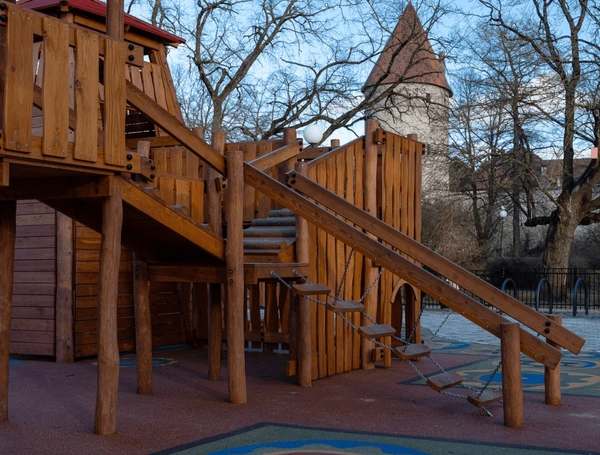
When a bespoke timber play structure or outdoor classroom lands on a Project Manager’s desk or a Quantity Surveyor’s cost sheet, it usually arrives as a beautiful landscape architect concept.
It looks fantastic in the CGI render. But turning that organic, artistic vision into an airtight, risk-managed tender package is where things can go sideways.
If you copy-paste standard generic steel/plastic clauses or rely on weak softwood descriptions, you create a commercial environment ripe for massive post-tender variations, supply chain substitutions, and structures that rot out long before their time.
At Monkey Business Design, we believe B2B procurement should be precise. If you are writing specifications or managing a bill of quantities, this highly technical checklist ensures you hold suppliers to strict BS EN 1176 standards, protect your client’s capital expenditure, and design out maintenance liabilities from day one.
Key Takeaways for the Procurement Team
- Legally Mandate BS EN 1176: Do not accept “designed to meet” promises; require independent, third-party post-installation certification written directly into the contract preliminaries.
- Specify Timber by Durability Class: Explicitly specify Class 1 Hardwoods (Robinia/Oak) under BS EN 350-2 to lock in a 20+ year lifecycle and eliminate toxic chemical maintenance.
- Ban Direct Softwood Ground Burial: Ensure all ground-contact posts utilise galvanised steel shoes or naturally durable hardwoods to insulate the structure against sub-surface fungal decay.
- Quantify NRM2 Sub-Bases Cleanly: Never allow a supplier to skimp on groundworks; a bespoke timber build requires a fully engineered, free-draining stone foundation to prevent structural settling.
- Mitigate Variation Risk Early: Ambiguous technical specs account for up to 33% of all post-tender variations in public sector works, tighten the material parameters before the ITT goes live.
The Material Spec: Are You Inadvertently Buying A 7-Year Asset?
From a cost-planning perspective, not all wood is created equal. Many standard playground tenders simply ask for “pressure-treated timber.” For a QS, this is a dangerous loophole that allows suppliers to quote using cheap, fast-grown Scandinavian softwood.
In the damp UK climate, these porous softwoods are highly susceptible to internal rot, frequently failing within 5 to 10 years.
To secure genuine long-term value, your technical specification must reference BS EN 350-2 (the European standard for the natural durability of wood).
The Technical Benchmark: Under BS EN 350-2, specifying a true Class 1 Hardwood like Robinia guarantees a natural, chemical-free service life of 20+ years even in direct ground contact, whereas standard softwoods drop dramatically in performance.
By specifying Class 1 Hardwoods or naturally durable Larch for above-ground features, you lock down a 20-year structural asset for the estate, driving down the whole-life cost cycle.
The Engineering Spec: How Are The Uprights Isolated From Moisture?
The primary point of failure for any outdoor timber structure is the ground-line transition zone, the exact point where the wood meets the soil, concrete, or tarmac. This is where oxygen, moisture, and microbes combine to destroy structural integrity.
When reviewing tender returns, verify the supplier’s structural engineering details against these two approved methods:
- Method A (Galvanised Steel Shoes): Uprights are suspended above the finished ground level using heavy-duty, hot-dip galvanised steel boots anchored into concrete pads. The timber never touches standing water.
- Method B (Naturally Dense Hardwood): If the design requires logs to go directly into the ground for a more organic look, the sub-surface timber must be a dense, sap-free Class 1 hardwood (like Robinia) that naturally resists fungal attack without artificial chemical treatments.
If a contractor submits a drawing showing treated softwood posts buried directly into wet concrete, reject it immediately. It represents a massive liability that will compromise the project’s compliance within a decade.
The Compliance Spec: Is The Design Independently Verified?
Public play areas, school academies, and community spaces must comply with BS EN 1176 (Playground Equipment and Surfacing Safety Standards).
However, because bespoke timber structures are built using organic, irregular logs, you cannot simply look up a factory model number in a compliance catalogue. Every single piece of craftsmanship must be engineered safely from the ground up.
Data from A&S Landscape highlights that approximately 80% of equipment-related playground accidents involve a fall to the surface. This means your structural spec and your surfacing spec cannot be divorced from each other.
Your tender documents should explicitly state that the specialist contractor must provide an independent, RPII-certified (Register of Play Inspectors International) Post-Installation Inspection Report before practical completion is signed off. This completely shifts the safety risk away from the Principal Contractor and Project Manager onto the specialist supplier.
The Commercial Matrix: The QS Tender Evaluation Checklist
When levelling bids from playground specialists, use this technical matrix to ensure you are comparing like-for-like quality rather than just looking at the lowest bottom line:
| Risk Category | What to Look For in the Tender Submission | The MBD Standard |
| Material Spec | Has the supplier specified the exact wood species and durability classification? | Class 1 Robinia/Oak (BS EN 350-2) for 20+ year lifecycle. |
| Compliance Proof | Do they provide structural calculations and a commitment to independent audits? | Full compliance with BS EN 1176, verified by independent RPII inspectors. |
| Groundworks Detail | Is the stone sub-base and drainage strategy clearly itemised under NRM2? | Fully engineered, free-draining foundations to prevent waterlogging. |
| Fixings & Hardware | Are the chains, nets, and structural bolts specified by material grade? | Grade 304/316 Stainless Steel and steel-core multi-strand ropes. |
| Maintenance Profile | Does the timber require annual chemical treatments or proprietary coatings? | Zero chemical treatment required; wood matures to a low-maintenance silver-grey. |
Why Proper Sub-Base Quantification Saves Your Contingency Budget
Incomplete or generic technical specifications are a primary driver of project cost inflation. Data tracking construction procurement reveals that unforeseen change orders and post-ITT variations typically add 10% to 15% to the final contract value of a development.
In timber play and landscaping projects, this financial exposure almost always occurs below the surface.
Specialist builders often quote solely for the visible timber structure while leaving the groundworks, drainage, and safety surfacing sub-bases completely undefined.
If the ground is poorly prepped, water will collect around the base of the timber, destabilising the foundations and causing premature rot. Ensure your bills of quantities clearly account for excavated soil disposal, structural geotextile membranes, and a compacted, free-draining stone base layer under NRM2 to keep your contingency budget fully protected.
Driving Risk Completely Out Of Your Timber Tender
Bespoke timber architecture doesn’t have to represent a procurement gamble.
By moving away from vague descriptions and writing strict parameters around BS EN 350-2 durability, BS EN 1176 safety compliance, and robust sub-surface isolation, you protect your client’s commercial interests.
You ensure that the finished installation isn’t just a beautiful design on day one, but a durable, compliant asset that lasts for decades.
Ready to assemble an airtight specification for an upcoming timber project?
Book a B2B Specification Review. Let’s look over your current bill of quantities and structural layouts to eliminate variation risks before you go to market.
FAQs
Can we specify “Robinia” generally, or do we need to specify sapwood content?
You must explicitly specify “sap-free Robinia.” The outer sapwood of any tree is prone to rapid decay; only the dense heartwood achieves the Class 1 durability rating.
Does BS EN 1176 apply to natural timber play as well as steel kits?
Yes. The safety standard is entirely material-neutral. It governs entrapment zones, fall heights, and structural loading regardless of whether the structure is plastic or hand-carved wood.
How do we handle NRM2 coding for bespoke timber layouts?
Classify bespoke timber builds under Component Band 5.6 (Fencing, Railings, and Walls) or 5.7 (External Fixtures), ensuring the concrete footings and specialist timber framing are quantified separately.
Is it cheaper to use steel-reinforced plastic posts instead of hardwood?
Initially, yes. However, plastic lacks structural rigidity over long spans and degrades under intense UV exposure, leading to higher lifecycle replacement costs compared to a 20+ year hardwood build.
What is the standard lead time for bespoke timber engineering?
From the final signing off of technical CAD drawings and structural calculations, expect a fabrication and installation window of 4 to 6 weeks, depending on the complexity of the terrain.
How do we verify a supplier’s timber is sustainably sourced?
Mandate the provision of Category A evidence (such as valid CoC certification invoices) in accordance with the latest UK Government Timber Procurement Policy guidelines.
Can a bespoke structure be easily modified if site conditions change post-tender?
Yes, this is a major advantage of timber. Unlike factory-moulded steel components, hand-crafted timber can be adapted, sculpted, and re-engineered on-site by skilled carpenters if unexpected services or ground obstructions are uncovered.