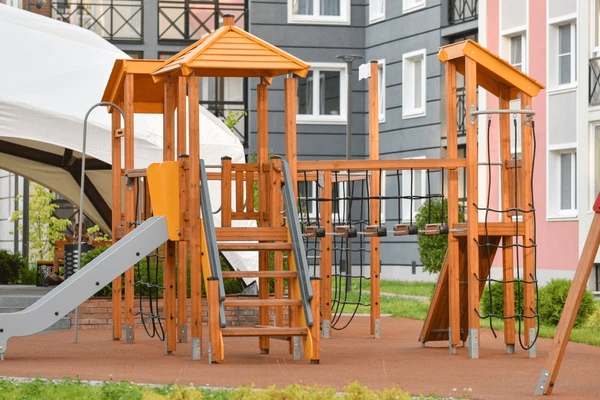
For a School Business Manager or Council Procurement Lead, the choice between a bespoke timber build and a standard catalogue kit often comes down to a simple question: “Which one is the best use of my budget over the next 15 years?”
At Monkey Business Design (MBD), we don’t just build playgrounds; we engineer site assets. Comparing a bespoke natural play supplier to a high-volume catalogue manufacturer is like comparing a tailored suit to one off the rack; the difference isn’t just in the fit; it’s in how the material performs under pressure.
Key Takeaways
- Bespoke play design adapts to your land’s natural slopes and features, eliminating the need for the costly ground levelling often required for “square” catalogue kits.
- Custom timber structures allow for “phased” construction, enabling schools to expand their outdoor space year-on-year as budget becomes available.
- Choosing hardwoods like Robinia or Oak removes the requirement for annual chemical staining and sealing that catalogue softwood demands.
- Every cubic metre of timber used in construction saves approximately 0.9 tonnes of CO2 emissions by storing carbon rather than producing it.
- Every MBD structure is engineered specifically for its location to BS EN 1176 standards, providing a custom design with full legal and insurance compliance.
Does Your Land Need To Fit The Kit?
A major hidden cost in catalogue procurement is ground preparation. Modular equipment is designed for flat, predictable surfaces.
If your site has a 10-degree slope, a catalogue supplier will often quote for significant earthworks, retaining walls, or concrete levelling just to make their “square” kit fit your “round” land.
Bespoke engineering works in reverse.
We use the slope as a play feature. By designing custom timber trails or amphitheatres that follow the natural contours of your site, we often eliminate thousands of pounds in unnecessary groundwork costs. We build with the land, not on top of it.
How to Design for Neurodiversity
Catalogue equipment is often loud, bright, and high-stimulation, which can be overwhelming for some students. Bespoke natural play allows us to design for the “sensory spectrum.”
By using natural textures, varied timber grains, and secluded den-like spaces, we create “low-arousal” zones within the playground. These areas provide a sanctuary for students who need a sensory break, reducing playground conflict and supporting inclusive social development.
A bespoke approach means we can place a quiet timber hub strategically away from high-traffic climbing zones, something a fixed-layout catalogue kit simply cannot accommodate.
Sustainability & The “Net Zero” School Estate
As schools move toward stricter environmental targets, procurement choice matters. Traditional playground kits rely heavily on plastics (high embodied energy) and galvanised steel (high carbon footprint).
There is also an emerging health consideration: research published in Moore Plastic Research indicates that playgrounds often contain higher concentrations of microplastics by five times more as compared to other urban park areas, primarily due to the degradation of plastic play structures.
By opting for English Timber, Larch, and Oak, you are choosing a renewable, biodegradable resource that stores carbon and keeps your site free from microplastic runoff.
How to Build a Legacy on a Rolling Budget
Schools rarely have the budget to transform an entire acre at once. Catalogue suppliers often push for large, “all-in-one” installations because their systems aren’t designed to be modular.
Bespoke design allows for phased growth.
We can design a “Master Plan” for your site that allows you to build a timber hub this year and a climbing tree next year.
For example, at Maiden Beech Primary, we built a large hexagonal platform around an existing tree with a wobbly bridge leading to a second platform, a design specifically engineered with “the option to add more in the future.”
The Comparison: Traditional vs. Engineered Bespoke Play
| Feature | The Catalogue Approach | The MBD Bespoke Approach |
| Primary Material | Pressure-treated softwood or plastic. | English Timber, Larch & Oak. |
| Typical Lifespan | 8–12 years. | 20–30+ years. |
| Carbon Impact | High (Steel/Plastic production). | Low (Carbon Sequestration in timber). |
| Maintenance | Annual chemical staining/sealing. | Occasional wash/Hardware check. |
| Aesthetic Value | Generic (looks like every other school). | Unique (High character/Solidly made). |
| Ground Contact | Timber-in-ground (high rot risk). | Galvanised metal feet (rot-proof). |
Proof Block: Real-World Site Integration
Project: Redcliffe Children’s Centre
In this popular city-centre nursery, we created a pair of tree platforms linked by a rope bridge as the centrepiece of a larger project. Unlike a standard kit, this bespoke build featured a “shop window” below and unique leaf-shaped cut-outs with coloured acrylic.
These project vibrant “autumn colours” inside the play space when it’s sunny, a level of sensory detail and site-specific character that off-the-shelf equipment cannot replicate.
Trust Element: Every MBD structure is original, solidly made, and engineered to BS EN 1176 standards. We focus on high play value and low environmental footprint, ensuring your investment is both safe and sustainable.
Buying for the Long Game
Procurement is about risk management. Choosing a catalogue kit is the “standard” route, but it often carries a high “maintenance debt.”
When you choose bespoke engineering, you are investing in a permanent piece of your school estate that grows with your students and respects your land.
Which supplier is really offering the best value? Book a Site Assessment, we’ll walk your grounds and provide a comparison that focuses on TCO, durability, and actual student engagement.
FAQs
Is bespoke play more expensive upfront than catalogue kits?
While initial costs can be slightly higher, the 30-year lifespan of hardwood makes it significantly cheaper over the project’s life-cycle.
Can we build bespoke play structures on a slope?
Yes. Unlike modular kits that need flat ground, we engineer our structures to follow the site’s natural contours and gradients.
Is custom-built timber play as safe as factory-made sets?
Every MBD structure is engineered to BS EN 1176 standards, providing the same certified safety as factory kits but with better design.
How does the maintenance differ between bespoke and catalogue?
Catalogue softwood needs annual chemical staining; our hardwoods age naturally and only require simple seasonal safety and hardware checks.
Can we add to a bespoke structure later if the budget increases?
Bespoke play builds are modular by design. We can create a master plan that allows you to add bridges or platforms in phases.