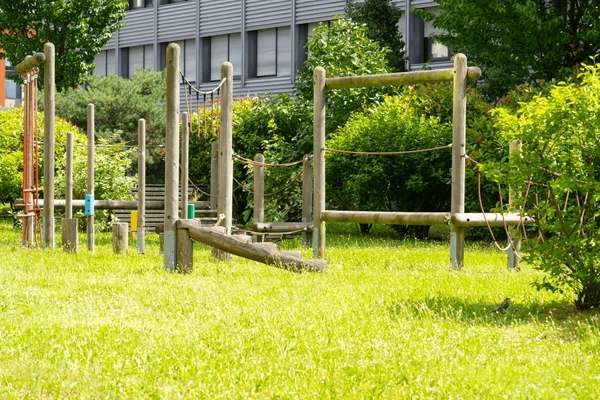
An outdoor classroom is not merely a “nice-to-have” landscaping feature; it is a strategically engineered educational hub designed to provide a permanent framework for discovery, social development, and managed risk.
At Monkey Business Design, we move away from the prescriptive, “one-size-fits-all” nature of catalogue equipment.
Instead, we focus on non-prescriptive infrastructure, like multi-level timber platforms and contoured seating, that can serve as a quiet reading area one hour and a base for Forest School tool work the next.
By choosing site-specific builds over flat-pack kits, schools can reclaim “dead zones” and turn them into functional, high-value assets that support the curriculum 365 days a year. Every structure we build is a one-time capital investment designed for a 20-year legacy.
Key Takeaways
- Psychological Priming: A defined perimeter helps children transition instantly into “learning mode” when stepping off the tarmac.
- Behavior Management: Dedicated social hubs provide essential “chill-out” zones, reducing playground friction and behavioral issues.
- 365-Day Access: Engineered surfaces and raised platforms mean the classroom is usable even in the depths of a UK winter.
- Pedagogical Flexibility: Our builds are “open-ended,” allowing teachers to adapt the space for science, drama, or group reflection.
- Environmental Integrity: We use Class 1 hardwoods that silver naturally, removing the need for annual chemical treatments or stains.
- Financial Legacy: We engineer for the long term. Our builds aren’t meant to be replaced in 10 years; they are built to last two decades.
Why Turn “Empty Space” Into “Functional Space”?
Most UK schools have plenty of green space, but surprisingly little of it is actually functional for teaching a full class of 30.
Without dedicated seating or shelter, outdoor lessons often descend into logistical chaos where the teacher’s focus is on management rather than instruction. This isn’t about “whoop-whoop” aesthetic design; it’s about reclaiming land that is currently being wasted.
The necessity for these spaces is supported by the 2024 Children’s People and Nature Survey (Natural England), which found that 91% of children report that being in nature makes them “very happy” (an increase from 85% in 2021).
Crucially, for 29% of participants, school is the primary place where they spend time in nature. By installing permanent outdoor seating, you aren’t just adding a bench; you are providing the only reliable nature connection many of your pupils will have all week.
How Do These Builds Support Different Types Of Learning?
The goal of a bespoke build is to match the infrastructure to the curriculum. We don’t do “off-the-shelf” because every school has a different pedagogical focus.
The Tiered Amphitheatre: Focus and Performance
By using the natural rise of a slope, we create tiered seating that provides a clear line of sight for every pupil. This is ideal for whole-class teaching, drama, or assemblies. It turns a difficult-to-mow incline into a high-capacity learning zone that anchors the school’s social life.
The Timber Discovery Hub: Risk and Research
Forest School requires a “safe zone” for tool work and group talks. Our hubs often feature raised timber platforms that keep pupils above the damp ground, allowing for 365-day access to woodland learning without the mess.
Sensory Nooks: Quiet Reflection and 1-to-1 Support
Not every child thrives in the noise of a main playground. We design small, sheltered “nooks” that provide sensory-neutral spaces. These are essential for pupils with SEND requirements or those who simply need a space to decompress before returning to the classroom.
What Does The Data Say About Behavior And Engagement?
It is a common misconception that outdoor play increases “wild” behavior. In fact, the opposite is true when the space is designed with clear boundaries and intentional seating.
According to research from Learning through Landscapes (LtL), an overwhelming 73% of schools reported that improving their outdoor learning spaces led to a direct and measurable improvement in student behavior. Additionally, 83% of schools saw a significant rise in the quality of social interaction and collaborative play among pupils.
From a physical health perspective, the Sport England Active Lives (2024/25) report shows that while activity levels are slowly recovering, only 49.1% of children meet the recommended 60 minutes of daily physical activity.
Outdoor classrooms engage the “non-sporty” 51% by getting them moving and learning in a diverse, non-prescriptive environment that doesn’t feel like a traditional PE lesson.
Which Infrastructure Matches Your Educational Outcome?
Choosing the right build requires balancing your site’s topography with your teaching goals.
| Build Type | Best For… | Measured School Outcome |
| Tiered Seating | Whole-class focus & performance. | 90% improvement in pupil focus during outdoor lessons. |
| Fire-Pit Hub | Risk management & social bonding. | 83% increase in quality social interaction and teamwork. |
| Thinking Nooks | Sensory decompression & SEND support. | 73% reduction in playground-related behavioral incidents. |
| Multi-Level Deck | Creative play & science observation. | 50%+ rise in academic performance and nature engagement. |
How Do We Engineer For The “Whole School” Journey?
A transformational site is one where the outdoor classroom is as accessible as the indoor one. We focus on the logistical journey between the classroom door and the seating area. If the route to the outdoor classroom is a muddy track, teachers will simply stop using it by November.
We solve this by engineering level-access boardwalks and slip-resistant platforms. By using localized “no-dig” foundations, we can build these paths over sensitive root systems, protecting your mature trees while providing a clean, all-weather route for wheelchairs and pupils alike.
This ensures that “nature for all” isn’t just a slogan, but a logistical reality on your site, even in mid-winter.
How Does Bespoke Infrastructure Address The “Nature Access Gap”?
The 2024 Children’s People and Nature Survey highlights a significant inequality: children in urban or less affluent areas are significantly less likely to visit woods or natural spaces outside of school hours.
For many of these pupils, the school grounds are their only point of contact with a high-quality natural environment.
A bespoke outdoor classroom bridges this gap by providing an “aspirational” space. Instead of a plastic play frame, children interact with raw English Oak and Robinia.
They experience the sensory change of the seasons from a solidly built, permanent structure that values their education as much as any indoor lab. This fosters a sense of stewardship and environmental concern that stays with them for life.
What Is The Environmental Impact Of Choosing Bespoke Timber?
Choosing a bespoke build mirrors the ecological values taught in Forest School.
- Carbon Storage: Every cubic metre of English Oak we use has locked away roughly one tonne of CO2. By building for a 20-year lifespan, these structures act as long-term carbon sinks.
- Chemical-Free soil: Standard pressure-treated timber leaches chemicals into the soil over time. Because we use naturally rot-resistant hardwoods, we eliminate the need for these toxins, keeping the soil where your children dig healthy and safe.
- Biodiversity Support: We prioritize timber from managed UK woodlands, supporting the recovery of local ecosystems rather than contributing to international deforestation.
Are Small Changes Worth The Investment?
You don’t need a massive capital project to transform how your pupils use the outdoors.
Sometimes, the most significant change comes from a simple, solidly made place to sit. By choosing site-specific engineering over “quick-fix” kits, you are making a long-term investment in your school’s curriculum, your pupils’ behavior, and your school’s physical legacy.
Ready to see what’s possible on your grounds?
Book a Site Assessment, we’ll walk your grounds with you and identify the simple builds that will have the biggest impact on your teaching.
FAQs
How do we stop the wood from becoming slippery?
We integrate resin-aggregate non-slip inserts into high-traffic steps and platforms. This provides a permanent, gritty surface that maintains high grip year-round.
Can these be built on urban tarmac sites?
Yes. We specialize in bringing nature to “grey” sites using raised timber platforms, integrated planters, and vertical seating to maximize small footprints.
What is the “no-dig” rule for tree protection?
To protect mature trees, we use a floating foundation with localized metal feet rather than digging trenches. This preserves the root protection zone (RPZ) and ensures the tree’s health for decades.
How many pupils can fit in a standard outdoor classroom?
Every build is bespoke. We typically design amphitheatre and fire-pit hubs to seat 30 pupils plus staff, ensuring there is enough space for movement and social interaction.